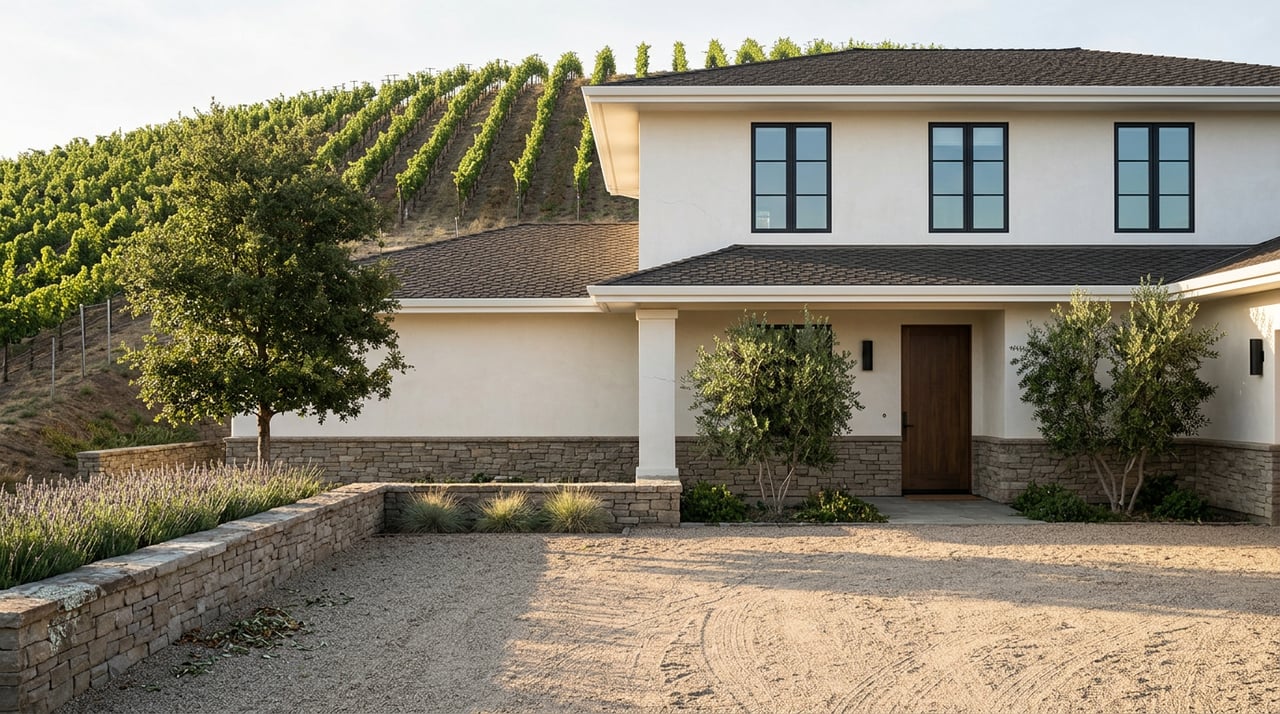
South Livermore's Vineyard Views Come With a Contract Nobody Reads at Closing
September 10, 2026
September 10, 2026
Drive Tesla Road east from downtown Livermore and the pattern repeats every few hundred yards: a custom home, then a wall of trellised vines, then another home, then more vines. It reads like landscaping. It isn't. Every one of those rows exists because thirty years ago, Alameda County and the city of Livermore made a specific trade with landowners, and the terms of that trade are still attached to the parcels, not to the view. If you're comparing a vineyard-adjacent home in South Livermore to a comparable property in Pleasanton or Dublin, the difference that matters most won't show up on the listing sheet. It's recorded against the title.
In 1993, facing vineyard land getting carved into subdivisions, the county and city adopted the South Livermore Valley Area Plan. The mechanism was simple and, for its time, unusual: in exchange for development rights near vineyards, a landowner had to plant five acres of irrigated agriculture, mostly wine grapes, for every acre of housing built. The goal, set jointly by officials, planners and vineyard advocates, was 5,000 acres of irrigated agriculture ringing Livermore, extending into Ruby Hill and the Vineyard Avenue corridor in Pleasanton.
That's why Vineyard Estates, the 694-acre development east of Ruby Hill, is subdivided into thirty-two twenty-acre parcels, each carrying one estate home and a vineyard covering roughly 90 percent of the property. It's the same reason Crane Ridge, west of Greenville Road, split its 243 acres into six residential and six winery-commercial parcels under the county's Cultivated Agriculture Overlay District, with most of the ground planted in wine grapes rather than lawn. The vines aren't an amenity the developer added for curb appeal. They're the collateral that made the housing legal to build in the first place.
This is where two homes that look identical from the street can diverge sharply. A home inside the gates of Ruby Hill, which sits just across the line in Pleasanton but was written into the same plan boundary, built around the Jack Nicklaus golf course and managed by an active homeowners association, gets its vineyard backdrop largely as scenery, courtesy of neighboring agricultural land and the character the specific plan protected regionwide. A home on one of the thirty-two Vineyard Estates parcels sits on ground where the vineyard planting and its conservation easement are part of that specific property's legal obligation, tied to the 90 percent agricultural set-aside that made the estate lot buildable at all.
The practical difference shows up at due diligence, not at the open house. An easement recorded against a parcel can restrict what you're allowed to add later: additional structures, expanded grading, changes to irrigation draw, sometimes even fencing that would interrupt the agricultural use. A county-commissioned special study of the area lays out sub-area boundaries, annexation history and easement status parcel by parcel, and it's public record if you know to pull it before writing an offer, not after.
The vines themselves aren't guaranteed permanent, either. Karl Wente, whose family has grown grapes in the valley since the 1880s, put the economics bluntly during a 2025 planning hearing on the commercial rules: without more visitor-serving development to support the industry, growers will keep pulling vines out rather than putting them in. A view that exists because a conservation easement requires it is a different asset, legally, than a view that exists because a grower is still finding the acreage profitable to farm.
For most of the plan's history, clustering, combining multiple parcels so commercial buildings could concentrate in one spot instead of spreading thin, wasn't allowed. That changed in 2025. The Alameda County Board of Supervisors approved amendments at its May 8 and June 5 meetings letting a landowner submit a clustering plan for any single parcel of at least 40 acres, or two or more adjoining parcels that together reach 40 acres. Parcels that take advantage of it and add a visitor-serving commercial use, a tasting room, an inn, a small restaurant, still have to keep at least 90 percent of the acreage in cultivated agriculture for as long as that commercial use operates. Parcels without a commercial use carry no such planting requirement. Within each 20-acre increment, an owner is entitled to one homesite, one two-acre building envelope, and up to 20,000 square feet of visitor-serving commercial space. Across the whole plan area, the amendments cap the net new commercial buildout at 150,000 square feet.
To put that number in context: since the original 1993 plan took effect, the valley has produced only about 30,000 square feet of visitor-serving commercial space total, essentially the ten-room Purple Orchid Inn and the Poppy Ridge golf course, shop and restaurant. The 2025 amendments authorize up to five times that amount going forward. For a buyer today, that means the empty pasture behind a vineyard-adjacent home is now more likely, not less, to become a tasting room, small inn or restaurant within the next several years than it was even two years ago.
The rule change alone doesn't build anything. Lodging over 14 rooms and any real restaurant can't run on septic, they need municipal sewer, and South Livermore has never had it. Livermore voters approved extending a sewer line into the area with no organized opposition, and the city has been moving on it since. As of an October 27, 2025 city council action, an agreement with Alameda County to fund preliminary design work is in place, covering a route that would connect to the existing line on East Avenue at Buena Vista, run south along Buena Vista, east along Tesla Road to Greenville Road, then south to Poppy Ridge and north to the Martinelli Center.
That timeline matters for anyone weighing a purchase near the plan area. A parcel that gets sewer access sooner is a parcel whose entitled 20,000 square feet of commercial space becomes buildable sooner. One long-running example: a proposed thirty-room Wine Country Inn near Hansen and Arroyo roads was approved by the city years ago, then successfully challenged in court for using a 50-foot setback where 100 feet was required. The city council reversed course and sent the project back for redesign. The Livermore Planning Commission approved the redesigned version in June 2026, a small but concrete sign that projects shelved by the old rules are starting to clear the process under the new ones.
Before writing an offer on anything inside or adjacent to the South Livermore Valley Area Plan boundary, it's worth confirming a few things directly with the title company or county planning staff:
None of that shows up in a standard disclosure packet. It shows up in county files and specific plan maps.
One more wrinkle worth knowing before comparing this pocket of Livermore to a subdivision in Manteca or a townhome in Dublin: sales volume inside these vineyard enclaves is thin enough that a single transaction can swing the headline number. Public listing aggregators pulling data on The Vineyards neighborhood in the 94550 ZIP code have shown, for overlapping windows in early 2026, a median sale price near $2.7 million with prices reported up close to 10 percent year over year, and separately a median closer to $2.3 million reported down roughly 3 percent year over year. The gap isn't a data error. It's what happens when a "median" is built from one or two closed sales rather than dozens. One aggregator's own methodology counted a single total home sold behind its headline percentage.
For a buyer, the lesson is to ask for the actual comparable sales, not the trend arrow. In a market this small, the arrow is noise.
Do I have to maintain the vineyard myself if I buy a home with an agricultural easement? It depends on the parcel. Some easements assign cultivation responsibility to the homeowner, others to a separate agricultural lessee or the HOA. The recorded easement document, not the listing description, will say which.
Will the 2025 clustering rules bring commercial development close to my home? Possibly, and sooner than in the past. The rules cap total new commercial space at 150,000 square feet across the whole plan area, but they no longer require it to spread thin. Check whether any clustering application has been filed on land adjoining a property you're considering.
Vineyard views in South Livermore are real, and for the right buyer they're worth what people pay for them. But the view is attached to a thirty-year land deal that just got its terms rewritten, and knowing which side of that deal a specific parcel sits on is the difference between an informed purchase and an expensive surprise two years into ownership. If you're weighing a move into this corner of the Tri-Valley, or trying to figure out what a property like this is actually worth once its obligations are accounted for, Valley to Valley Realty can walk the parcel history with you before you write an offer. Get Your Home Valuation and start with the numbers that actually apply to your specific piece of ground.
Stay up to date on the latest real estate trends.
Whether you’re buying, selling, or planning ahead, Valley To Valley Realty is here to guide you with clarity and purpose. Reach out today and take the next step toward a confident real estate future.
Get In Touch With Us
VALLEY TO VALLEY REALTY
Francine Masudi | CA DRE# 02236450
(209) 513-3323
[email protected]
Rick Arciniega | CA DRE# 01101436
OFFICE HOURS
Monday - Friday
9AM - 5:00PM
ADDRESS 3017 Douglas Blvd, STE 300 Roseville, CA, 95661