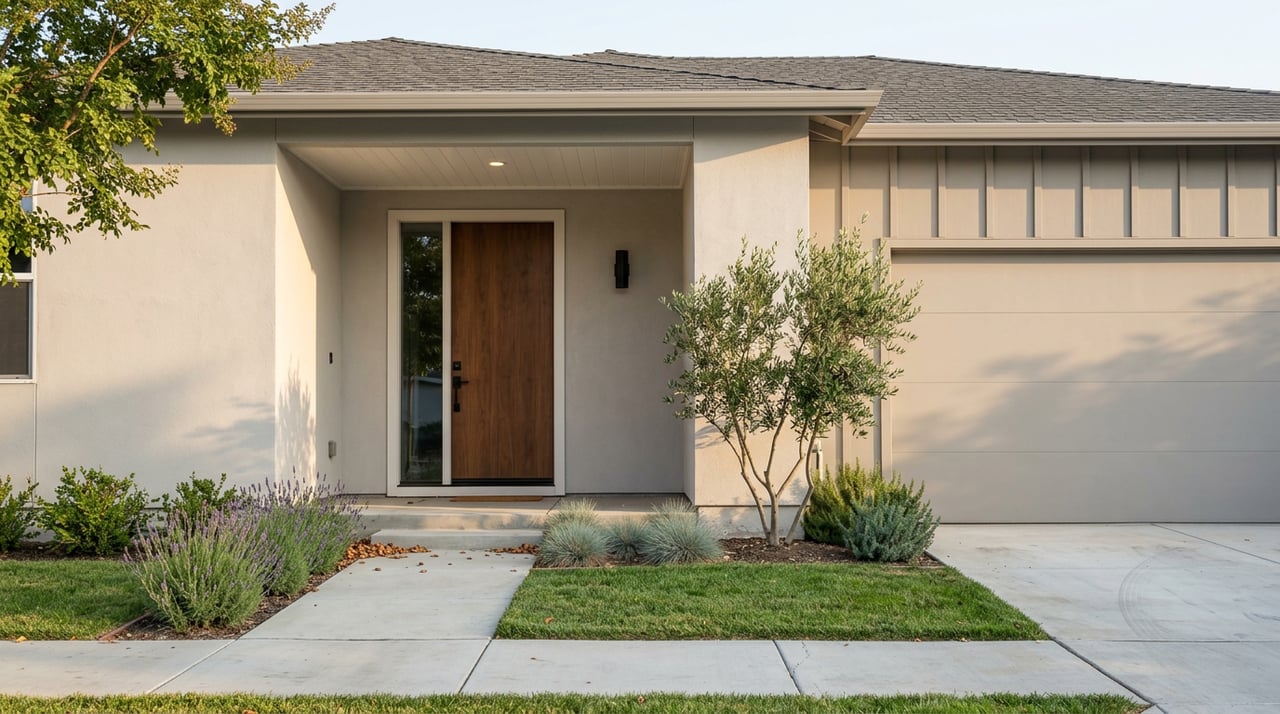
Manteca Housing Market 2026: Three Markets to Watch
August 20, 2026
August 20, 2026
Is the Manteca housing market up, down, or holding steady heading into the back half of 2026? Ask that question across three market segments and you'll get three honest answers, because Manteca right now isn't one market. It's three, moving in different directions at the same time, and the citywide median you saw on a portal search last week combines all three into a single citywide figure.
That matters if you're comparing Manteca to Tracy, Lathrop, or a Tri-Valley commute swap, because the headline number tells you almost nothing about what you'd actually pay depending on which Manteca you're shopping in.
By August 2026, homes listed for sale in Manteca carried a median asking price of $649,000, down 3 percent from a year earlier. That's the number sellers are typing into their listings. It is not the number buyers are paying. Over the three months ending May 2026, tracked closed sales showed a median sold price of $595,000, down 5.5 percent year over year, with price per square foot at $297. By August, that per-square-foot figure had slipped further, to $290. Line up the asking and closing numbers and you get a gap of about $54,000 between what sellers are still asking today and what buyers were actually paying to close as recently as this spring.
Days on market tell the same story from a different angle. Listings were already sitting a median of 64 days back in February 2026. By August, that had stretched to 87 days. None of that is a market in free fall. It's a market where sellers are still pricing off last year's comps and buyers are the ones setting the pace.
But here's the part a citywide average can't tell you: that leverage doesn't exist evenly across Manteca. It's concentrated almost entirely in one kind of market segment, and nearly absent in two others.
Start with Del Webb Woodbridge, an active adult community with floor plans ranging from about 1,300 to 2,740 square feet. Amenities include a Lakeview Clubhouse with an indoor pool and spa, a fitness center with an elevated, glass-enclosed walking track overlooking Lake Rockwell, and a full-time activity director running everything from water aerobics to a drama club. Purchases here may be funded by home equity rather than a fresh mortgage, making them different from rate-sensitive move-up purchases in a market where mortgage costs are what many buyers are negotiating around.
Then there's the city's established resale stock, neighborhoods built out over the last several years rather than in the current construction cycle. This is where the citywide slowdown actually lives. These are the listings sitting the longest, absorbing the biggest gap between ask and close, and giving buyers the room to negotiate that the citywide averages describe.
And then there's active new construction. Griffin Park alone spans multiple builder sections, including its Sendero and Arroyo phases, while Oakwood Trails spans Pulte's Amber and Willow collections alongside Taylor Morrison's Poppy and Sage lines, evidence that both communities are well into multi-phase selling rather than freshly launched. Pricing reflects that momentum. Current listings show a to-be-built Patagonia floor plan at Griffin Park starting at $826,000, while quick-move-in homes at Oakwood Trails have listed as low as $667,880 and as high as roughly $830,000. That's a spread of roughly $73,000 to $235,000 above the spring's citywide resale median, in some cases for comparable square footage. Builders control their own release pace and lean on rate buydowns and other incentives instead of price cuts, so their listings don't show the same softness that resale inventory does.
| Submarket | Price / Size Signal | What's Driving Pricing | Buyer Profile |
|---|---|---|---|
| Del Webb Woodbridge (55+) | Homes roughly 1,300-2,740 sq ft | Equity-funded purchases, low rate sensitivity | Buyers comparing community amenities |
| Established resale (built over the last several years) | Resale median near $595,000 (spring 2026) | Longest days on market, biggest ask-to-close gap | Move-up and first-time buyers |
| Active new construction (Griffin Park, Oakwood Trails) | From near $552,000 to roughly $830,000 | Builder-controlled release pace, rate buydowns over discounts | Relocating buyers |
A buyer comparing "Manteca" to "Tracy" on a portal search is really comparing one blended number to another. The market segment you choose within Manteca changes the math more than the city-to-city comparison does.
One useful comparison for anyone cross-shopping the corridor: Tracy hasn't cooled at the same rate Manteca has this year. Tracy Hills, an active phased new-home community, is still releasing inventory starting around $647,880 in 2026, a price point that sits above even the top end of Griffin Park's entry pricing in Manteca, where similar new homes start closer to $552,000. A steady flow of fresh, appreciating-priced inventory in one city, set against a market leaning more heavily on resale absorption in the other, is a reasonable piece of why the two cities are cooling at different speeds this year, separate from anything mortgage rates alone would explain.
Location plays its own role. New construction at Griffin Park sits off Highway 120, with easy access to Interstate 5, Interstate 580, and Highway 99, putting it roughly 35 minutes from Dublin. That kind of multi-directional access serves commuters heading toward Stockton, Modesto, and Sacramento as easily as those heading toward the Bay Area, which is part of what keeps Manteca on the list for cross-valley buyers even in a year when the freshest master-planned energy in San Joaquin County is tilting toward Tracy.
If you've seen headlines about new homes at River Islands pricing past $1 million, that community sits across the interchange in Lathrop, not Manteca. It's a different city, a different builder mix, and a different product entirely, including a program where every closed sale there contributes $5,000 toward attracting employers to a planned business park. Worth knowing before you assume a $1 million headline says anything about what you'd pay inside Manteca city limits.
Rate cycles come and go, but the more durable explanation for buyer leverage in Manteca is supply already working its way through city approvals. As of March 1, 2026, Manteca had roughly 13,757 homes and apartment units somewhere in the entitlement process, according to reporting from the Manteca Bulletin. If every one of those units gets built out at the city's typical household size, it would add about 44,022 residents, close to the entire current population of neighboring Lathrop. A chunk of that pipeline, 2,154 units, sits north of Union Road, an area of the city that hasn't seen this kind of building activity before.
That's the mechanism worth watching longer than any single month's median price. A market with that much supply already queued up tends to stay buyer-friendly for a while, regardless of where mortgage rates land next.
Does the citywide median include new construction? Most trackers blend resale and new-build closings into one figure, which is part of why the number looks softer than what you'll actually find priced at a builder's community like Griffin Park or Oakwood Trails.
Is Manteca still cheaper than Tracy? On new construction specifically, yes. Griffin Park's entry pricing starts near $552,000, well under Tracy Hills' $647,880 starting price this year. The bigger difference right now is how much fresh, appreciating inventory each city has moving through its pipeline, not commute distance alone.
Three markets, one zip code, and a median that only tells you the average of all three. If you're weighing a move into Manteca, or comparing it against a Tri-Valley or Bay Area starting point, the market-segment numbers matter more than the citywide headline. Valley to Valley Realty, led by Francine Masudi, works through exactly this kind of market-by-market breakdown with buyers and sellers across the Central Valley and Tri-Valley corridor. If you want a clear read on what your specific Manteca purchase or sale actually looks like against current data, get your home valuation and start the conversation from real numbers instead of a single median.
Stay up to date on the latest real estate trends.
Whether you’re buying, selling, or planning ahead, Valley To Valley Realty is here to guide you with clarity and purpose. Reach out today and take the next step toward a confident real estate future.
Get In Touch With Us
VALLEY TO VALLEY REALTY
Francine Masudi | CA DRE# 02236450
(209) 513-3323
[email protected]
Rick Arciniega | CA DRE# 01101436
OFFICE HOURS
Monday - Friday
9AM - 5:00PM
ADDRESS 3017 Douglas Blvd, STE 300 Roseville, CA, 95661