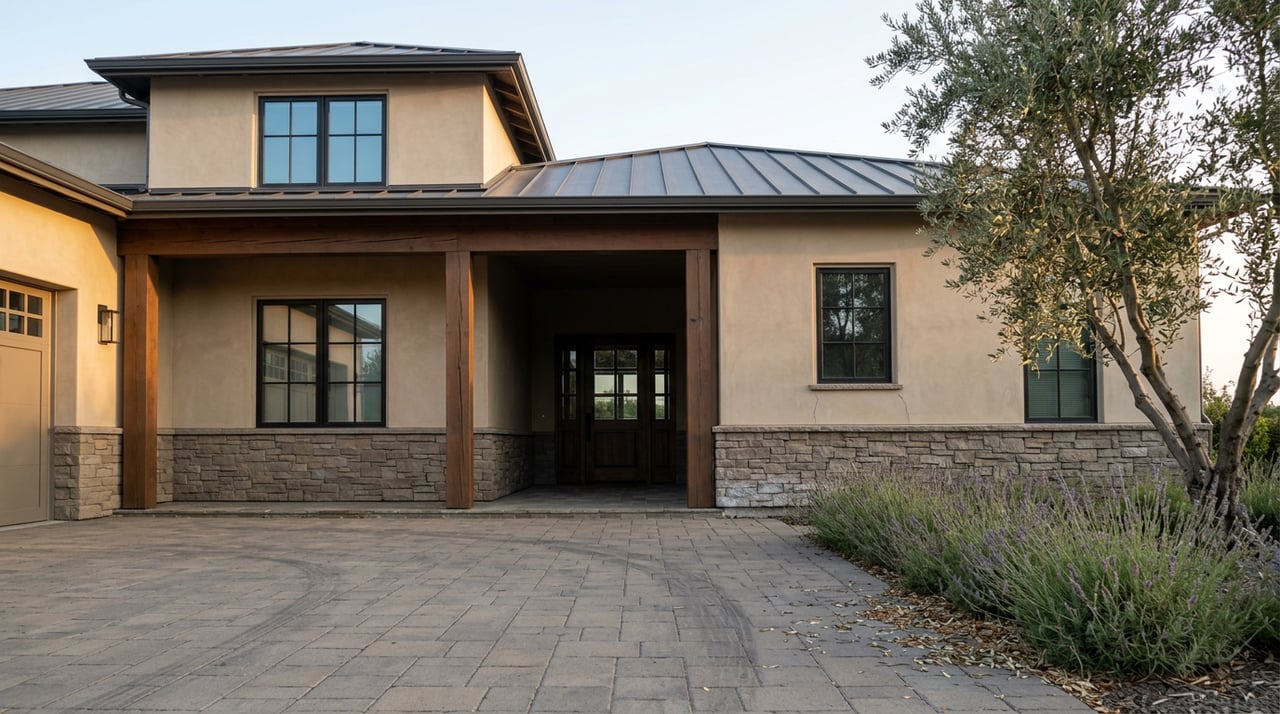
What Ruby Hill Pleasanton Home Prices Really Show
September 24, 2026
September 24, 2026
Pull up Ruby Hill's housing numbers from last year and the headline looks simple: median sale price up 48.8 percent year over year, to $4.3 million, off nine closings in a single month. Look at price per square foot for that same stretch and it moved the opposite direction, down 5.6 percent. Same gated community. Same data provider. Same window. Two numbers pointing at opposite conclusions.
That is not a typo, and it is not two different markets quietly hiding inside one zip code. It is what happens when a neighborhood built on roughly 900 lots, ranging from 2,000-square-foot production homes to custom estates north of 10,000 square feet, produces single-digit sales in a typical month. The math is not broken. The sample is just too thin to carry the weight most buyers put on it.
The closed sales tell a more useful story than the median does, mostly because they refuse to average themselves into a tidy narrative.
| Address | Sold | Size | Price | Price per sq ft |
|---|---|---|---|---|
| 488 Montori Ct | Feb 4, 2026 | 2,806 sq ft | $2,150,000 | $766 |
| 496 Montori Ct | Apr 30, 2026 | 2,296 sq ft | $2,110,000 | $919 |
| 3630 Pontina Ct | Mar 5, 2026 | not disclosed | $5,500,000 | — |
Two homes on the same court, sold three months apart, landed within $40,000 of each other on price. Yet the smaller one sold for $153 more per square foot, which is the kind of gap that has nothing to do with market direction and everything to do with lot position, finish level, and whichever buyer showed up that week. A few streets over, Pontina Court closed at two and a half times either Montori sale that same spring.
Layer in the two largest transactions of the year, a 7,590-square-foot home on West Ruby Hill Drive that closed September 14, 2026, and a 9,812-square-foot estate on Piemonte Drive that closed June 11, add either one to a month with only eight or nine other sales, and the median jumps by hundreds of thousands of dollars without a single existing homeowner's equity actually changing. That is the mechanism behind last year's 48.8 percent headline. It was not universal appreciation. It was a couple of large houses closing in the same window.
Ruby Hill's production homes run 2,000 to 3,200 square feet. Its custom estates run 4,000 to well over 10,000. Both categories share one HOA, one gate, and one median calculation. When a month's closings lean toward custom estates, the median climbs. When they lean toward production homes, it falls back. Neither move tells you whether the neighborhood as a whole is worth more or less than it was twelve months ago.
Local agents circulate sales like the one on Parma Court, which they called the highest price the neighborhood had seen in a decade, as proof of momentum. That framing is understandable. In a market with this few comps, one custom sale genuinely can be the biggest print in years, simply because there have not been many chances for a bigger one to happen. Rare does not mean trending.
The instability shows up even among professional data providers. One widely used real estate site puts Ruby Hill's trailing 12-month median at $3.71 million and calls it flat versus the prior 12 months. Another site tracking the same window puts the identical dollar figure at down 9 percent year over year. Same address range, same rolling period, opposite conclusions about direction.
That disagreement is not a data error to hunt down. It is the natural result of running year-over-year math on a pool of transactions small enough that swapping two or three sales in or out changes the sign of the answer. Anyone using a single Ruby Hill statistic to argue the neighborhood is heating up or cooling off is reading more precision into the number than the sample supports.
If the real signal is not in Ruby Hill's own numbers, it shows up in the wider $3 million-plus tier across Pleasanton, where there are simply more transactions to average.
A local brokerage's monthly market report tracked that segment through August 2026 and found it leading 2025's pace as recently as May, with 22 sales against 21 the year before. By June it had slipped one sale behind. By August the gap had widened to 11 sales year to date, 29 against 40 at the same point in 2025, and the report noted the direction had held for three consecutive months. The luxury tier is cooling, not accelerating, at exactly the moment a single Ruby Hill snapshot suggested the opposite.
Citywide, the same report put Pleasanton's August 2026 median sale price for detached single-family homes at $1.5 million, down 9.7 percent from August 2025's $1.66 million, the first year-over-year decline the report had logged since it began monthly tracking in May 2026. Redfin's own citywide figures for the three months ending August 2026 land in the same range, a median of $1.5 million, down 8.1 percent year over year, with 137 homes sold in August against 178 the year before. Two independent trackers, same direction, same order of magnitude. That is what a large enough sample looks like.
While the top of the market thins out, the $1.3 million to $1.699 million band has done the heavy lifting all year, accounting for 36.8 percent of every Pleasanton home sale through August 2026. Days on market citywide stretched to 36 in August, up from 29 a year earlier, and active inventory sat at roughly 72 listings, about 1.9 months of supply. Sellers were still closing at 99 percent of list price on average, so this is not a market where lowball offers are landing, but it is a market with more room to look before committing than the spring gave anyone.
Pleasanton's ability to support a luxury tier at all traces back to what sits a few miles from Ruby Hill's gate. Hacienda Business Park alone employs more than 13,500 people across roughly 680 companies, and the city's median household income was $186,206 as of the Census Bureau's most recent estimate. That income base is what keeps a $2 million production home and a $5.5 million custom estate both finding buyers in the same zip code, even in a year when the median between them refuses to sit still.
A handful of practical adjustments follow from all of this:
The gate, the Jack Nicklaus-designed course, and the vineyards surrounding wineries like Fenestra do not change the arithmetic. They explain why buyers pay a premium to be inside the gate at all. What happens to that premium month to month depends on which nine houses happened to close, not on some broader force lifting or lowering every home in Ruby Hill together.
Is Ruby Hill losing value? Not based on anything in this data. The broader luxury segment across Pleasanton is cooling in terms of sales pace, but that is different from individual home values declining. Price per square foot in Ruby Hill fell over the same period the median rose, which argues against a clean story in either direction.
Why do luxury prices swing more than starter-home prices? Fewer transactions. Pleasanton's $1.3 million to $1.699 million band saw well over a hundred sales in 2026 alone, enough that a handful of unusual closings barely move the average. Ruby Hill's entire annual sales count would not fill a single month in that lower tier.
How should I judge a Ruby Hill asking price? Ask for the size and finish level of the last three to five comparable sales, not the neighborhood's trailing median. In a market this thin, the right comp set is a short list of specific addresses, not a citywide average.
If you are weighing a move into Ruby Hill, pricing a custom estate for sale, or trying to figure out what the broader Pleasanton luxury market is actually doing this fall, Valley to Valley Realty can walk through the specific comps that matter for your situation. Get Your Home Valuation and start with numbers built for your address, not a citywide average.
Stay up to date on the latest real estate trends.
Whether you’re buying, selling, or planning ahead, Valley To Valley Realty is here to guide you with clarity and purpose. Reach out today and take the next step toward a confident real estate future.
Get In Touch With Us
VALLEY TO VALLEY REALTY
Francine Masudi | CA DRE# 02236450
(209) 513-3323
[email protected]
Rick Arciniega | CA DRE# 01101436
OFFICE HOURS
Monday - Friday
9AM - 5:00PM
ADDRESS 3017 Douglas Blvd, STE 300 Roseville, CA, 95661